
QUEIJOS SCALA
Warehousing and Order Fulfillment Solution
Scala’s sustained growth required freeing up production space and improving logistics efficiency.
Laticínio Scala, a manufacturer of Scala-brand cheese, cottage cheese, and butter, needed to free up space in the manufacturing area where it stored its finished products and increase the efficiency of warehousing and order fulfillment, against a backdrop of market growth of around 10% annually. To this end, the company entrusted ULMA Handling Systems with the construction and automation of its first distribution center in the city of Sacramento.
Scala Cheeses
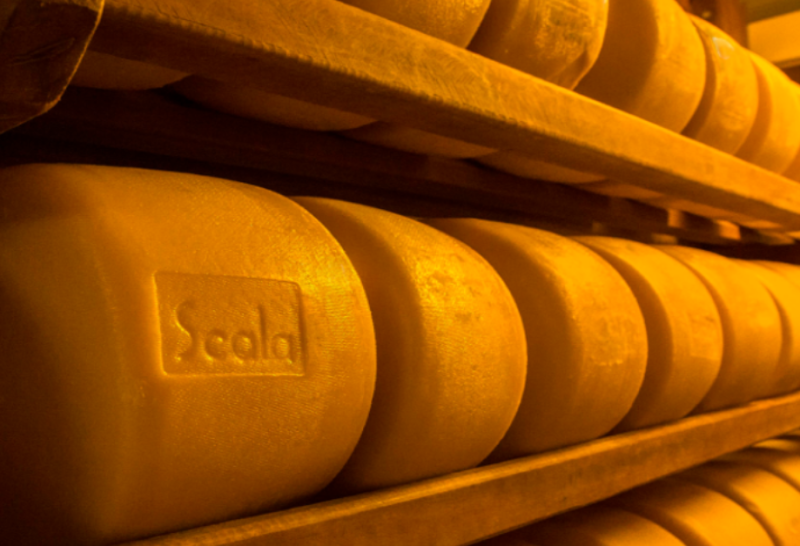
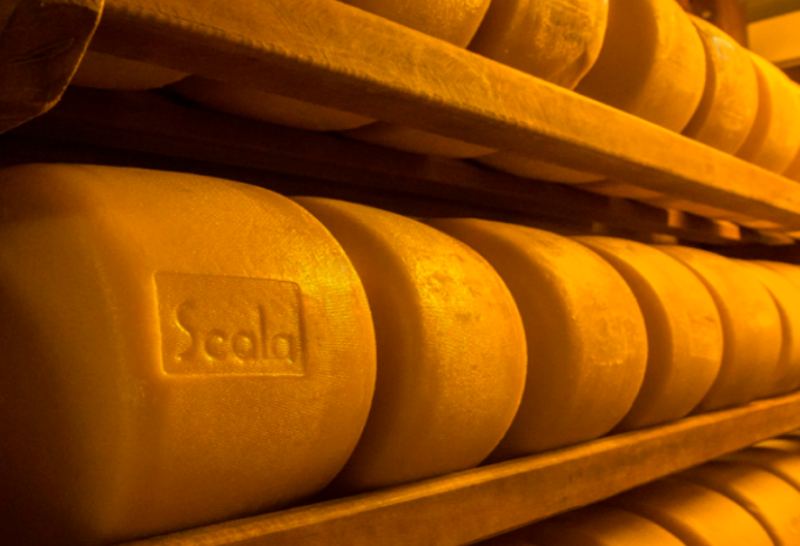
Laticínio Scala is one of Brazil's leading cheese manufacturers. Headquartered in Sacramento (Minas Gerais) and with several factories in the region, the company now operates throughout Brazil, with a product portfolio that includes Parmesan, Provolone, Gorgonzola, Brie, mozzarella, cottage cheese, cream cheese, and butter, among others. It is recognized for combining Italian and Minas Gerais traditions with innovation and high quality standards.
The Challenge
Laticínio Scala needed to free up space in its manufacturing area—where finished products had previously been stored—and improve the efficiency of its warehousing and order fulfillment operations. Market growth—around 10% annually—also required a solution that would ensure logistical control and efficiency, with high standards of quality and freshness for its products—managed across three distinct temperature-controlled ranges—within a conventional storage model using pallet racking.

Freeing Up Space in the Factory

Management of three temperature ranges

A rapidly growing business

Maintain high quality standards
The solution
from ULMA
ULMA Handling Systems’ project for Laticínio Scala includes a high-performance system for automated storage and order fulfillment, consisting of a warehouse equipped with a Compact System pallet (unit load) stacker crane, with a capacity of 1,400 pallets. This is ULMA’s first project in Brazil for the food industry in a temperature-controlled environment: the warehouse operates between 2°C and 4°C, the picking area between 8°C and 10°C, and the shipping area between 12°C and 14°C.
For order fulfillment, the project includes a “pick-to-belt” system, where products are picked directly from the pallet and placed on a 150-meter roller conveyor. This process is guided by “Pick to Light” displays, automatic labelers, and a case sorter at the end of the line, capable of sorting 16,000 cases per day. The entire operation is supported by IK-LOG, the warehouse management system developed by ULMA, which interfaces with Scala’s enterprise management system.
The result
At Laticínio Scala, loss reduction is effective thanks to inventory management software configured to implement FIFO (first in, first out) and production batch control, which are essential in the food industry. The distribution center, which covers 7,000 m² and directly supplies the states of São Paulo, Minas Gerais, and Goiás, is operating at 70% of its capacity and will serve Laticínio Scala through 2021, when the company will be able to expand its storage area further, including the addition of two more stacker cranes.

Effective Loss Reduction

FIFO and Production Batch Control

Direct supply to 3 states

Scalable solution
Testimonial
"In addition to striving to improve our logistics processes, the growth of our market presence—at a rate of about 10% per year—has motivated us to invest in a solution that could provide us with logistical control and efficiency, along with high standards of quality and freshness for our products. As one would expect, innovation is a constant in our strategic planning, and this project as a whole represents a major step forward—for the industry as well."
Darley Ferreira
Process and Project Coordinator at Laticínio Scala
"We decided to build the distribution center and automate it for two reasons: the need to free up space in the manufacturing area, where finished products are currently stored, and to increase the efficiency of warehousing and order fulfillment."